
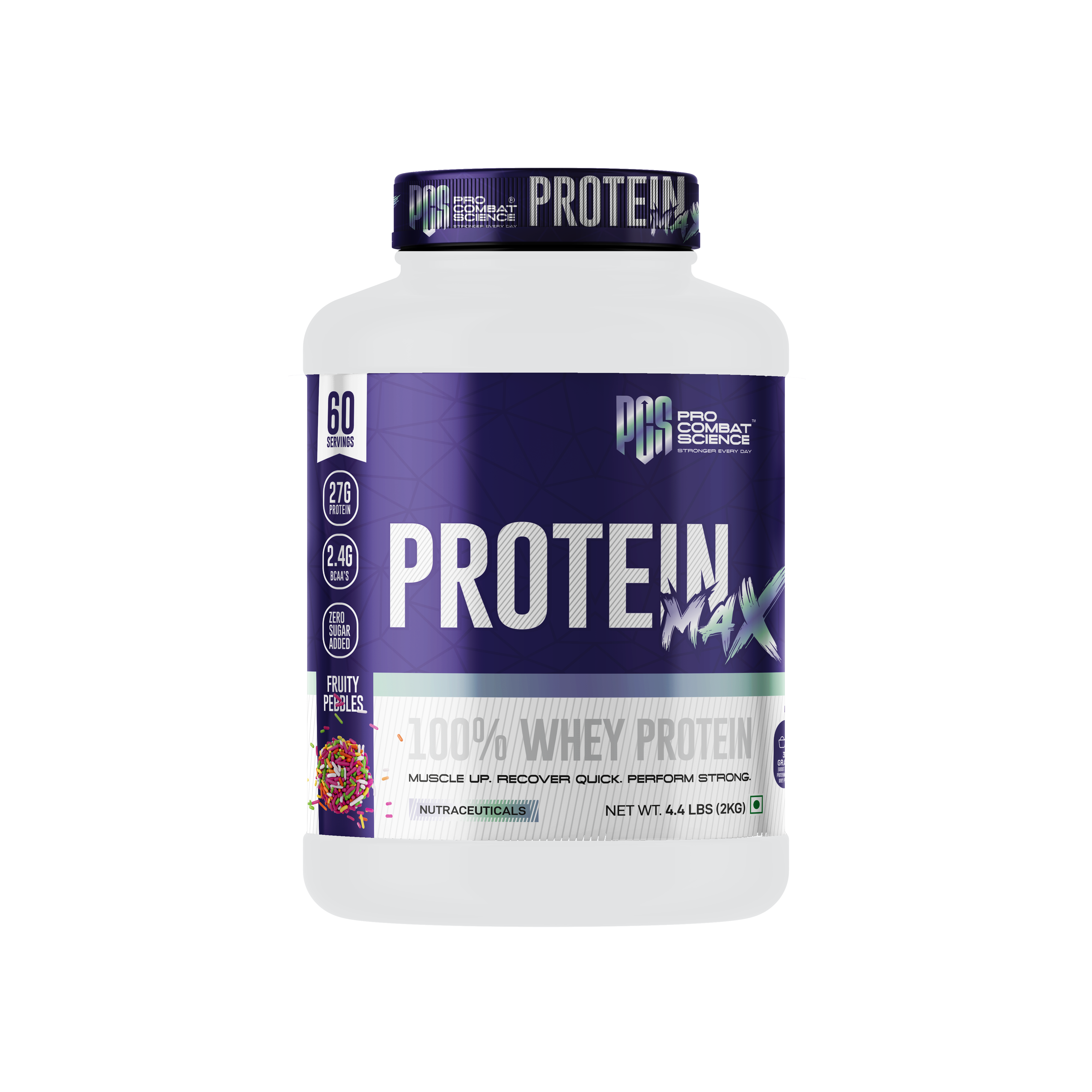
How much protein is in one scoop of protein powder?
There is no single number that applies to every scoop. A scoop measures a volume of powder. The label states the intended serving in grams and the protein provided by that amount. For example, a 30 g serving of powder is not automatically 30 g of protein: the powder may also contain carbohydrate, fat and other ingredients.
Read the serving statement and nutrition panel together. If directions describe more than one scoop as a serving, do not mistake the serving's protein amount for the amount in one scoop. Use the actual label rather than a generic answer copied from another product.
Work out protein for the amount you use
If a hypothetical powder declares 24 g protein per 30 g serving, its declared protein fraction is 24 ÷ 30 = 0.8. A measured 15 g amount would provide 15 × 0.8 = 12 g protein, using the declared values.
This example explains the arithmetic; it is not a PCS product claim or a recommendation to change the label's serving directions. Nutrition declarations can be rounded, so calculated results are estimates rather than a laboratory measurement of your shake.
The formula is: your powder weight × labelled protein per serving ÷ labelled powder weight per serving.
Compare protein on an equal basis
Suppose Pack A declares 24 g protein in a 30 g serving and Pack B declares 27 g in a 40 g serving. B has a larger protein number per serving, but the serving is also larger.
- A per 100 g: 24 ÷ 30 × 100 = 80 g protein.
- B per 100 g: 27 ÷ 40 × 100 = 67.5 g protein.
That comparison answers a concentration question, not every buying question. It does not establish which pack tastes better, fits your allergies, has the right ingredient mix, or suits your needs. Read the rest of the label before deciding. Our sports-nutrition label guide gives a broader checklist.
How to calculate the cost per serving
For an illustrative 1,000 g pack with a stated 30 g serving and a price of ₹2,000:
- Estimated servings: 1,000 ÷ 30 = about 33.3.
- Estimated cost per serving: 2,000 ÷ 33.3 = about ₹60.
A label may state an approximate serving count. Small differences caused by rounding do not make the calculations identical to a guarantee about how many perfectly measured servings you will obtain.
For a more realistic budget, use the amount you will actually pay after any applicable discount and add delivery charges. If an offer needs a larger order, calculate whether that larger order still makes sense for you rather than treating the advertised discount as an automatic saving.
What does cost per gram of protein tell you?
You can calculate an additional comparison: estimated serving cost divided by declared protein per serving. In the same hypothetical example, ₹60 ÷ 24 g = ₹2.50 per gram of declared protein.
This is a price comparison, not a product-quality test. A low number does not prove authenticity, safety, ingredient quality or suitability. Do not compare a whey powder and a mass gainer using only that number, because you may be buying them for different roles. Read whey protein versus mass gainer for that distinction.
Check before you buy
- Use the same units throughout: convert kilograms to grams before dividing.
- Confirm the exact flavour and pack size; do not assume all variants have identical prices.
- Read ingredients, allergens, serving directions and storage instructions.
- Check expiry information and whether you can use and store the pack as directed.
- Keep your invoice and check the seal when it arrives.
These arithmetic examples are independent of any brand's current price or nutrition. For actual PCS variants, browse whey protein and consult the current product page and received pack. For Indian label requirements, consult the FSSAI regulations resource; the examples here are buying tools, not legal advice.